For most visitors to Israel, an eSIM is the simplest way to get online the moment the plane lands: you buy it on your phone, scan a QR code, and keep your home SIM in place. The catches are small and avoidable, and they all come down to choosing the right plan: a phone that is unlocked and compatible, a plan that includes a local number if you need one, and honest data terms. Our 350GB Israel eSIM, with a local +972 number, 3,000 call minutes and 1,500 SMS, is built around exactly those points.
This guide walks through what an eSIM does well in Israel, where travelers run into trouble, and how to avoid every one of those problems.
TL;DR
- An eSIM is a digital SIM: no card to buy at the airport, no swapping, and your home number stays active on the same phone.
- The main things to check are that your phone is eSIM-capable and carrier-unlocked, and that the plan includes a real local number if you need calls or ride and delivery apps.
- Many travel eSIMs are data-only, and "unlimited" plans usually carry fair-use limits, so read the data terms before paying.
- Flat prepaid eSIM pricing is typically far below carrier day passes. Our plan is $25 for 350GB, with +972 number, calls and texts included.
- Install it on home Wi-Fi before you fly, so any problem gets solved before you land.
Table of Contents
- What an eSIM is and why it suits a trip to Israel
- The advantages of an eSIM in Israel
- The catches, and how to avoid each one
- eSIM, physical SIM or roaming: a quick comparison
- Who gets the most from an Israel eSIM
- How to choose well: a short checklist
- Perspective: why we built the plan this way
- Get connected before you land
- FAQ
- Sources
What an eSIM is and why it suits a trip to Israel
An eSIM is a SIM built into your phone. Instead of a plastic card, you add a mobile plan by scanning a QR code or tapping an install link. A phone can hold several plans and use two at once, which is why you can keep your usual number for texts while a separate Israel plan carries the data.
That design fits Israel well. Visitors typically arrive at one main gateway, Ben Gurion Airport near Tel Aviv, tired, with luggage, and need a map, a ride app and a way to message their hotel or host within minutes. Hunting for a kiosk or a retail shop first is the opposite of that. With an eSIM bought in advance, you connect as soon as you leave airplane mode.
The advantages of an eSIM in Israel
You are online on arrival
There is nothing to collect and no queue. Buy the plan, install it, and switch it on when you land. Our eSIM activates instantly on arrival with a QR code scan, with no physical swap and no setup at the airport.
Your home SIM stays in your phone
Dual-SIM operation means you do not have to pop out your regular SIM and tuck it somewhere safe. This matters more than it sounds: banks, employers and two-factor login systems often send verification codes by text to your home number. Keeping that SIM active for incoming texts, with its data roaming switched off, while the eSIM handles data is the setup many frequent travelers prefer. Our eSIM is designed to work in just this dual-SIM way without removing the home SIM.
A local number can be part of the plan
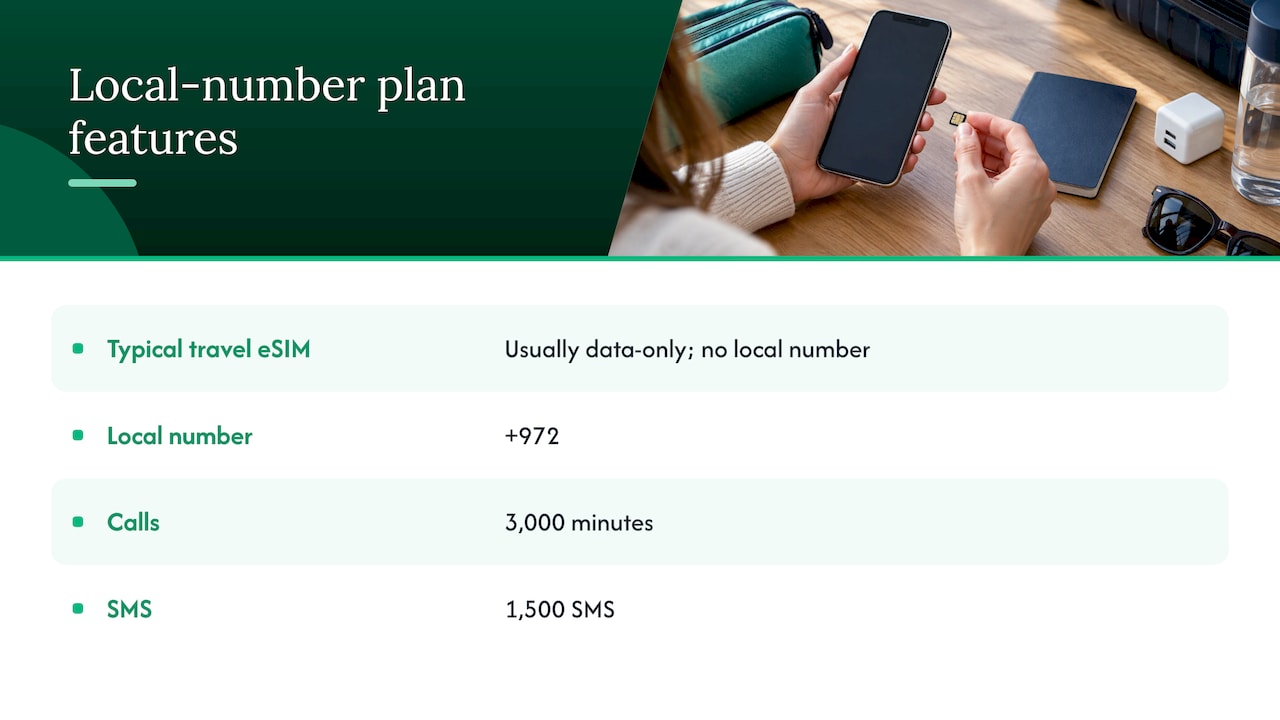
This is where plans differ most. Many travel eSIMs give you data only. Newsweek's November 2026 survey of travel eSIMs points out that most are data-only with no local number. In Israel, a local number is useful for more than phone calls: delivery and ride apps, hotel check-ins and restaurant reservations commonly want a number they can text or call. Our plan includes a local +972 number, 3,000 minutes of calls and 1,500 SMS, so those everyday interactions work like they do for a resident. More on how that plays out is on our Israel eSIM +972 number page.
Flat prepaid pricing instead of day passes
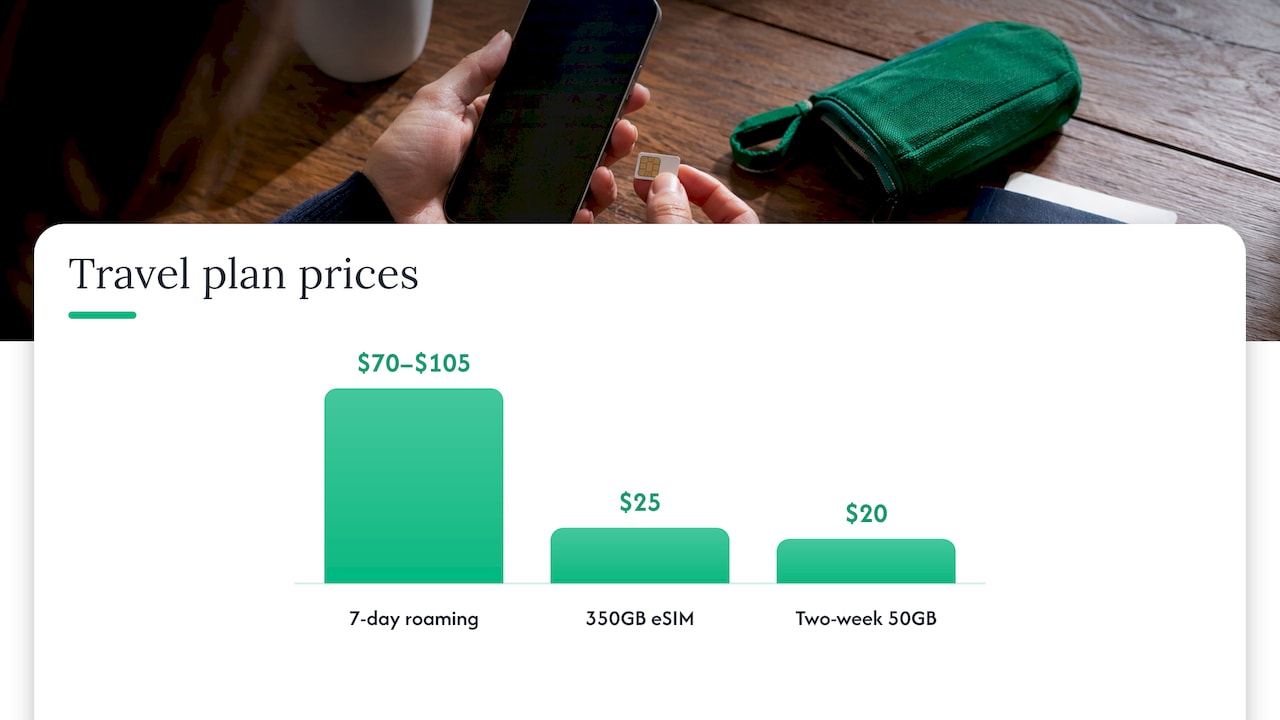
Roaming from a US carrier is usually billed per day. One travel-cost comparison puts typical Western carrier Israel day passes at USD 10 to 15 per day, so a week adds up quickly. A prepaid eSIM is a single purchase. Ours is $25 for 350GB of 5G data, with no hidden fees, and our two-week plan with 50GB and a number is $20. For a line-by-line comparison of the two approaches, see our Israel eSIM vs roaming cost breakdown.
Mobile data is a safer default than public Wi-Fi
Hotel, café and airport Wi-Fi is convenient, but your own mobile connection is generally the safer choice, particularly for banking, payments and sensitive accounts, as travel eSIM providers quoted by Newsweek note. Having your own data plan means you never have to log in to a shared network to pay for a taxi or check a reservation.
You can buy it from anywhere, any time
There is no shipping. You can buy and install the plan from your couch the week before, or at your departure gate if you forgot. The earlier, the better, as the next section explains.
The catches, and how to avoid each one
None of these is a reason to skip an eSIM. They are the checks that separate a smooth arrival from a stressful one.
Your phone must support eSIM and be unlocked
Most recent iPhones, Pixels and Samsung Galaxy flagships support eSIM. Older and budget models may not, and a phone locked to a carrier may refuse a plan from another provider. Newsweek's travel eSIM roundup flags both older or budget phones and carrier-locked phones as the common reasons an eSIM fails.
Check before you buy:
- On an iPhone, open Settings, then General, then About, and look for a Digital SIM or EID entry, and "No SIM restrictions" under Carrier Lock.
- On Android, look under Settings, then About phone, for an EID number; Samsung owners will find extra detail in our Samsung eSIM in Israel guide.
- If your phone is financed through your carrier, ask the carrier to confirm it is unlocked.
Our list of compatible phones covers iPhone, Samsung and Pixel models, and there are dedicated pages for iPhone and Android.
Some plans are data-only
If you only need maps and messaging apps, data-only works. If you expect to phone a restaurant, receive a delivery driver's call or verify a local account by SMS, you want a number. Decide this first, then pick the plan. Ours includes the number, calls and texts.
"Unlimited" rarely means unlimited
The same Newsweek piece notes that "unlimited" travel plans almost always come with fair-use limits and throttled speeds once you pass a threshold. The practical fix is to compare allowances in gigabytes and to read the terms on hotspot sharing and speed after the limit. A very large allowance removes the question altogether: 350GB is far more than a typical trip needs, and our 350GB eSIM page shows who benefits from that much. If you are specifically looking for no-cap browsing, see what "unlimited" really means for Israel eSIMs.
Setup works best before you travel
The moment of installing the eSIM is the only fiddly part. A traveler would rather discover a problem at home than at a baggage carousel. The advice in Newsweek's roundup is to buy before you leave so you can check compatibility, install over home Wi-Fi and reach support without roaming charges. The same article suggests treating the QR code like a password, since it is a one-time install key: do not post it or send it around, and do not delete the eSIM from your phone once it is installed, because it usually cannot be reinstalled.
Signal depends on the network behind the plan
An eSIM is not a weaker kind of connection. Signal quality comes from the mobile network the plan runs on, not from the SIM format. Israel's operators differ in coverage. Field measurements published in nPerf's 2026 Israel coverage barometer, covering 1 September 2025 to 31 August 2026, put Partner first for 4G coverage and Pelephone first for 5G coverage, based on real-user measurements. Results shift year to year, and city centers are far better covered than remote desert roads. If you plan to drive between regions, see our guide on local versus regional Israel eSIMs, road coverage and IPs. Our plan runs on a local network and delivers 5G where it is available; for a deeper look at the carrier behind it, read our Pelephone eSIM comparison.
eSIM, physical SIM or roaming: a quick comparison
| Israel eSIM | Local physical SIM | Home carrier roaming | |
|---|---|---|---|
| Getting it | Buy online, install by QR code | Collect at an airport kiosk or shop | Already on your account |
| Swap needed | No | Yes, home SIM out | No |
| Home number stays active | Yes (dual SIM) | Only with a second slot | Yes |
| Local +972 number | Included with our plan | Often | No |
| Pricing | One flat price | One-off, varies by pack | Per day or per MB |
| Works on older phones | No, needs eSIM support | Yes | Yes |
The right answer depends on your phone. If it supports eSIM and is unlocked, the eSIM column wins on convenience and on cost, and our flat plan keeps the bill predictable. If your phone has no eSIM support, a physical SIM is the route the hardware allows.
Who gets the most from an Israel eSIM
- Short-trip tourists: a first-time visitor landing in Tel Aviv or Jerusalem needs a map, rides and messaging straight away. We have specific pages for Tel Aviv and Jerusalem.
- Business travelers: a local number and large data allowance let you take calls, run hotspot for a laptop and keep your home number for verification codes.
- Backpackers: no SIM swapping means no lost cards, and a big allowance covers video calls, uploads and offline map downloads.
- Anyone who wants heavy app use: social media, streaming and navigation all run from one plan.
How to choose well: a short checklist
- Confirm your phone supports eSIM and is carrier-unlocked.
- Estimate your data. Your phone's cellular usage settings show what you use in a normal week; multiply by the length of your trip.
- Decide whether you need a local number for calls, texts and app verification.
- Read the terms on hotspot use, fair-use limits and when the plan's validity clock starts.
- Buy and install the plan on home Wi-Fi before you fly, then switch it on when you land.
Perspective: why we built the plan this way
We started from what a visitor to Israel actually does in the first hour: order a ride, message a host, pay for something, and look up where to eat. Each of those goes more smoothly with a local number and a connection that is already on, so we put the +972 number, 3,000 minutes and 1,500 SMS in the plan alongside the data.
We also think data should never be the thing you ration on holiday. 350GB of 5G at a flat $25 means you can stream, navigate and share a hotspot without watching a meter. The eSIM sits beside your home SIM, so your usual number keeps receiving texts and nothing has to come out of your phone.
Our advice is simple: check your phone, install early, and travel with your connection already sorted.
sabraconnect
Get connected before you land
We offer a 30-Day Traveler plan and a 14-Day Traveler plan: prepaid, delivered by QR code, with a local +972 number, calls, texts and 5G data, for iPhone and Android with no SIM swap. Pick your length on our Israel eSIM page, and install it at home before the flight.

If you are only staying two weeks, our two-week Israel eSIM gives you 50GB plus a number for $20.
FAQ
Is there a downside to using an eSIM in Israel?
The things to watch are practical ones: your phone must support eSIM and be unlocked, and some plans are data-only or limit speed under "unlimited" terms. Check those before you buy, and install the eSIM on home Wi-Fi so you are ready on arrival.
Do I need an eSIM for Israel?
You need some way to get mobile data, and an eSIM is the quickest one if your phone supports it. It avoids airport shopping and per-day roaming fees, and it keeps your home number on the phone. If you also want local calls and app verification, choose a plan with a +972 number.
Do eSIMs get worse signal?
No. An eSIM uses the same mobile network as a physical SIM would on that network; the SIM format does not change reception. What matters is which network the plan runs on and where you are, since coverage is stronger in cities than in remote areas.
Can I keep my home number while using an Israel eSIM?
Yes, on a dual-SIM-capable phone. Leave your home SIM in place for texts and verification codes, turn off its data roaming, and use the eSIM as your data line. Our eSIM also gives you a separate local +972 number.
Which phones work with an Israel eSIM?
Recent iPhones, Pixels and Samsung Galaxy models generally do, as long as they are carrier-unlocked. See our Israel eSIM compatible phones guide for the full list.
Sources
- Newsweek: Most Popular Travel eSIMs, Which Ones Are Worth It, and the Catches to Know
- nPerf: Barometer of mobile coverage in Israel 2026