Israel has four main mobile operators, and the gap between them is smaller than the marketing suggests. For a visitor, the network matters less than three practical things: that your phone is unlocked, that you land with data already working, and that you have a local +972 number for the SMS codes, delivery apps and hotel calls that run on it. That is why we built our 350GB 5G eSIM with a local number, 3,000 call minutes and 1,500 SMS, activated by QR code on arrival. Below is how the networks actually compare, and how to turn that into a decision.
TL;DR
- Israel has ten mobile brands but only three physical antenna networks, so most "different" carriers share the same towers.
- Independent measurements rank the big four close together on coverage, and the ranking changes depending on whether you measure 4G, 5G, speed or consistency.
- Check that your US phone is carrier-unlocked and supports eSIM before you fly.
- A local +972 number matters more than most visitors expect, because many Israeli services verify by SMS.
- Our eSIM gives you 350GB of 5G data, a local number, calls and texts, with no SIM swap.
Table of Contents
- Who actually runs the networks in Israel
- How coverage and speed compare
- What changes for a short stay
- Roaming, kiosk SIM or eSIM
- Will your American phone work?
- Where you are going matters more than who you pick
- Our point of view
- Get connected before you land
- FAQ
- Sources
Who actually runs the networks in Israel
Israel's market looks crowded and is not. Expat Focus lists four main operators: Cellcom, Partner, Pelephone and HOT Mobile, with around a dozen smaller brands on top. Mordor Intelligence describes the same structure: four operators dominate the national radio infrastructure, while the smaller brands, called MVNOs, target price-sensitive niches.
An MVNO (mobile virtual network operator) owns no towers. It buys capacity from a big operator and sells it under its own name. The same Mordor report notes that operators share towers through a neutral-host company, and that Cellcom's acquisition of Golan Telecom added roughly 900,000 subscribers to its side of the market.
In practice, the Hebrew-language overview of Israeli cellular communications says 5G began in 2022 over Pelephone, Cellcom and a shared Partner and HOT network. So when you compare Israeli brands, you are mostly comparing three radio networks, not ten.
Ownership, as The Olam reported in November 2026, is a mix of corporate and investor holders: Pelephone belongs entirely to Bezeq, while Cellcom, Partner and HOT Mobile each have separate investor groups. Visitors do not need to track this. What they need is how the networks perform where they will be.
How coverage and speed compare
There is no single official scoreboard, so the useful approach is to read two independent studies and notice where they agree.
Opensignal: experience scores
Opensignal's December 2025 report covers measurements collected from 1 September to 29 November 2025. Its figures:
| Operator | Coverage experience (out of 10) | 5G download speed (Mbps) | 5G coverage experience |
|---|---|---|---|
| Cellcom | 8.7 | 256.0 | 3.7 |
| Partner | 8.3 | 329.7 | 3.4 |
| Pelephone | 8.2 | 170.5 | 5.0 |
| HOT Mobile | 7.4 | 157.1 | 3.0 |
The same report shows 5G availability ranging from 48.7% to 61.2% of the time across operators. Read that as a reminder that 5G in Israel is widespread but not constant, and that your phone will often fall back to 4G.
nPerf: geographic and population coverage
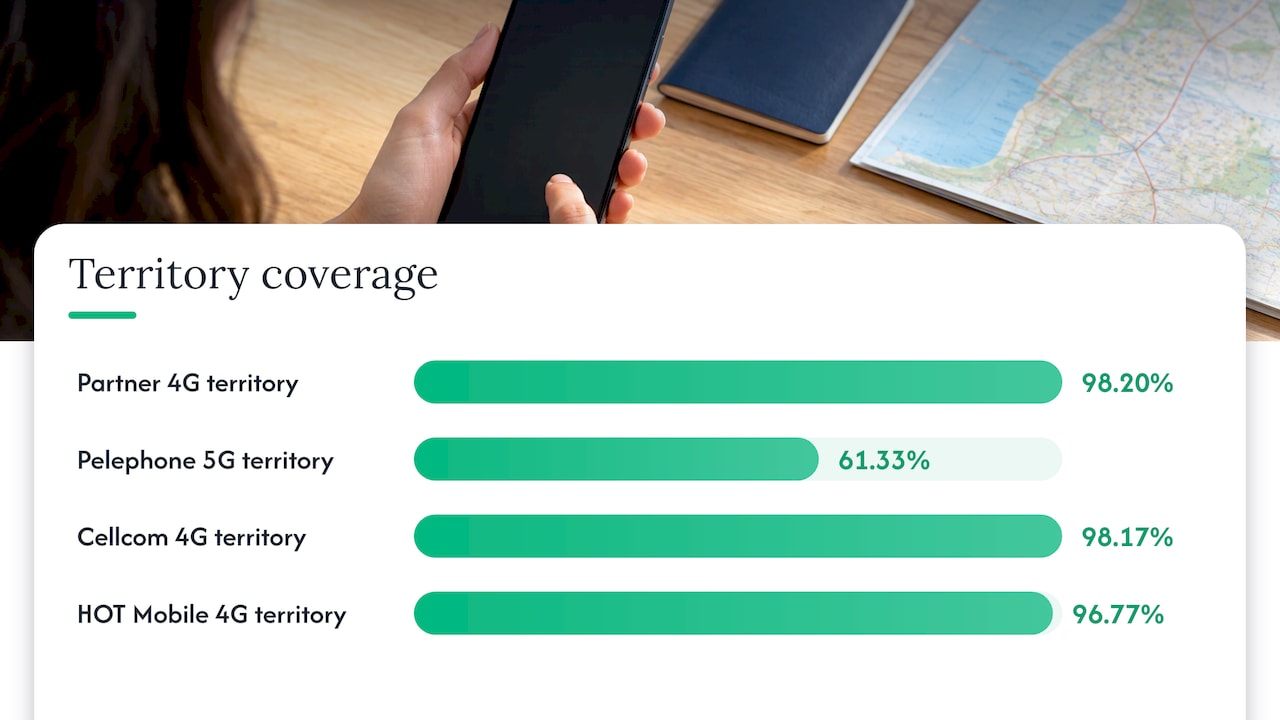
nPerf's 2026 coverage barometer uses measurements from 1 September 2025 to 31 August 2026. It found Partner with the best 4G coverage (98.20% of the territory, 99.53% of the population) and Pelephone with the best 5G coverage (61.33% of the territory, 82.58% of the population). Cellcom and HOT Mobile came close behind on 4G, at 98.17% and 96.77% geographic coverage.
nPerf also explains something travelers often miss: low 700 MHz bands reach further but deliver lower speeds than 3.5 GHz bands. A map full of 5G does not mean fast 5G everywhere.
What the two studies tell you
Each operator leads somewhere: Cellcom on overall coverage experience, Partner on 5G speed and 4G reach, Pelephone on 5G coverage. Nobody wins every column. For a trip of one to four weeks, the differences between the big three are small next to the difference between having working data on landing and not having it.
Israel's Ministry of Communications is also working on this. In August 2026 it announced a proposed overhaul of coverage and quality rules, including 99% continuous coverage on roads and railways and a cap of 1% on dropped or blocked calls per hour. It also publishes an interactive cellular map built from crowdsourced speed tests, where you can look at your hotel's neighborhood hexagon by hexagon.
If you want a plain-language walk through the same question for visitors, we wrote one on checking two live maps for Israel 5G coverage and another on what coverage maps show and miss. For realistic numbers on the device in your hand, see our guide to eSIM speeds on 4G and 5G in Israel.
What changes for a short stay
The operator comparison is written for residents who sign up for a line and keep it for years. A visitor has different needs.
You need data from the moment you land. Ride apps, maps, ticket QR codes and messaging all assume you are online at the arrivals hall. Waiting in a queue for a physical SIM costs time you would rather spend at the beach.
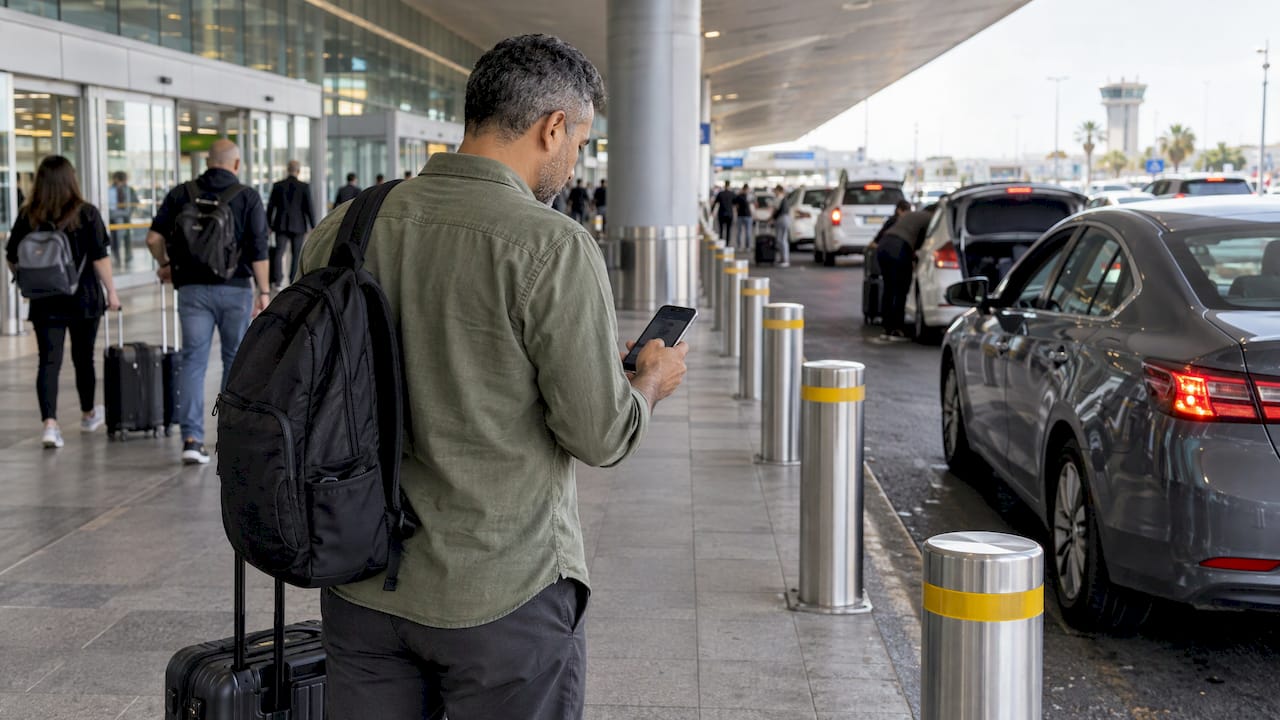
You need a local number. Jerusalem Local notes that banks, health funds, municipalities and delivery drivers reach customers by SMS and WhatsApp, and that foreign numbers do not always receive verification codes. For a tourist the version of this is a hotel confirmation, a restaurant call or a courier at the door. Our page on the +972 number for Gett, Wolt and hotels covers how that plays out.
You want to keep your home SIM. Many travelers want their US number on for bank texts while using a local line for everything else. An eSIM sits alongside your physical SIM, so there is nothing to remove or lose.
You want a plan you do not have to ration. Local plans are often described as unlimited, but the real terms live in the fine print. Whatever you choose, read the data allowance, any speed reduction after a threshold and whether calls and texts are included before you pay.
Roaming, kiosk SIM or eSIM
There are three types of option for a visitor.
- Travel eSIM with a local number. You buy online before the flight, scan a QR code and connect on arrival. This is our approach, and it is the one that fits the needs above best.
- Prepaid SIM from a local operator. Expat Focus says visitors can buy these with a passport at operator stores, mall kiosks or from resellers. It works, but it means a stop, a queue, a physical card to swap in and your home SIM out of the slot.
- Home-carrier roaming. It needs no setup, which is its appeal, and its cost depends on your plan. We compared the daily and pay-as-you-go terms in our guides to AT&T roaming in Israel, T-Mobile roaming in Israel and EE roaming in Israel.
By comparison, our flat-priced eSIM gives you a large data allowance, a local number and no hidden fees, which is why we recommend it as the first choice for a trip of any length. A plan with data only leaves you without a number, so check what is included. Our page on the Pelephone eSIM plan versus data-only travel eSIMs goes through the differences.
Will your American phone work?
Two checks before you buy.
Is the phone unlocked? Year in Israel's guide, checked in October 2026, says an iPhone should show "No SIM restrictions" under Settings, General, About, Carrier Lock. If your phone is financed or still tied to a US carrier, ask that carrier to unlock it. For other phones, the same guide suggests asking the carrier or trying another carrier's SIM.
Does it support eSIM? Recent iPhones and many current Android models do. Unlocking removes the carrier restriction but does not guarantee support on an older or unusual device, so confirm the exact model on the plan page before you pay. We keep separate pages for iPhone and Android, and our support page answers the questions customers raise most.
If you are asking whether T-Mobile or any other US brand is tied to Israeli networks: no US carrier gives you a home network in Israel. Using one there means roaming on a local operator, with whatever pricing your plan sets.
Where you are going matters more than who you pick
In the big cities, all four operators deliver usable 4G and frequent 5G. Differences show up at the edges: the Negev, the Dead Sea, desert roads, the far north and some indoor spots.
This is another reason to look at local maps and not at a national average. The ministry's map lets you inspect the specific area, and the nPerf figures show 4G reaching more than 96% of the territory for every operator, with 5G reach lower and more uneven. For the two places most visitors spend time, we wrote area guides for Tel Aviv and Eilat. If you plan to use your phone for video calls from a hotel, our comparison of mobile data and Wi-Fi speed in Israel shows what to expect from each.
A practical rule for different trips:
- Heavy data use (streaming, hotspot, remote work): choose a plan with a large allowance rather than one that throttles after a few gigabytes.
- Business calls: a local +972 number lets clients and drivers reach you without international charges.
- Backpacking: an eSIM avoids buying a new card at each stop and keeps your home SIM safe.
Our point of view
Comparing Israeli networks is useful, and it also misleads. The four operators sit within a point or two of each other on most independent scores, and each leads on a different measure. For a visitor, that means the carrier brand is rarely the thing that decides whether the trip goes smoothly.
What decides it is whether data works the moment you land, whether you have a local number, and whether you are watching a meter. That is how we designed our eSIM: 350GB of 5G data, a local +972 number, 3,000 minutes of calls and 1,500 SMS, delivered by QR code, working alongside your home SIM on iPhone and Android.
We price it as one flat plan and we aim to keep it free of hidden fees, because the usual problem for travelers is not the network but the surprise at the end of the trip. Choose the plan, scan the code and spend your attention on the trip.
sabraconnect
Get connected before you land
Our 30-Day Traveler and 14-Day Traveler plans give you 350GB of high-speed 5G data, a local +972 number, 3,000 call minutes and 1,500 SMS, with unlimited app browsing on select platforms. You activate by scanning a QR code on arrival, with no SIM swap. See the plans and current pricing on our Israel eSIM page.

FAQ
Which mobile network is the best in Israel?
There is no single winner. In Opensignal's December 2025 report, Cellcom had the highest coverage experience score, Partner the fastest 5G downloads and Pelephone the best 5G coverage experience. For a trip, choose the plan with the data, number and activation you need, and check the ministry's map for the areas you will visit.
Can I use my American phone in Israel?
Yes, if it is carrier-unlocked and supports the bands and eSIM in use. Check the Carrier Lock line in your phone's settings and confirm your exact model before buying. Our eSIM works on iPhone and Android without removing your home SIM.
Is T-Mobile affiliated with Israel?
No. Israel's networks are run by local operators, and a US carrier only reaches them through roaming. An Israeli eSIM replaces that with a local connection and a local number.
How many mobile networks does Israel really have?
Ten brands operate, but they share a smaller number of physical networks. The four main operators are Cellcom, Partner, Pelephone and HOT Mobile, and the smaller brands resell capacity from them.
Sources
- Israel - Landlines and Mobile Phones, Expat Focus
- Israel Telecom MNO Market Report, Mordor Intelligence
- Israeli cellular communications overview (Hebrew)
- The Olam: Israeli mobile carriers ownership
- Opensignal: Israel Mobile Network Experience Report, December 2025
- nPerf: Barometer of mobile coverage in Israel 2026
- Israel Ministry of Communications: coverage and quality overhaul
- Ministry of Communications cellular map
- Jerusalem Local: Mobile phone plans in Israel
- Year in Israel: Phones and Internet